Why Decluttering Feels So Emotionally Exhausting (And What To Do About It)


Nobody warns you that decluttering can make you cry.
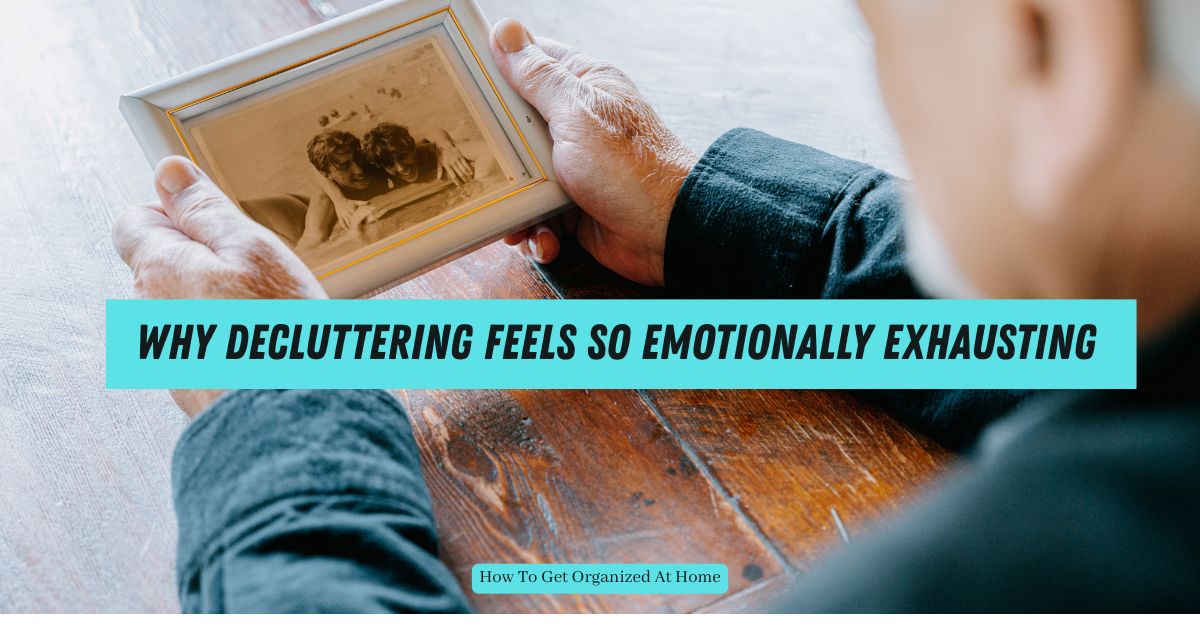
Or that you’ll pick up something completely ordinary, an old mug, a jacket you haven’t worn in years, a birthday card from someone no longer here, and suddenly you’re not tidying a shelf anymore. You’re grieving, remembering, or processing something you didn’t even know you were still carrying.
Why decluttering feels emotionally exhausting is simply because it is.
Most decluttering advice focuses on the stuff itself: what to keep, what to throw away, and how to organise it all neatly once you’re done. But clutter is rarely just about stuff. That’s why so many ideas to declutter your home can feel so unrealistic.
And why you can look at a pile of things and feel completely overwhelmed before you’ve even started. You’re not just sorting objects. You’re sorting memories, guilt, hopes, expectations, and sometimes parts of yourself.
If you’ve ever wondered why decluttering feels so much harder than it seems like it should, there’s usually a reason underneath it.
Affiliate links are included for your convenience. (This means if you purchase after clicking a link I will earn a small commission which won’t cost you a penny more!) Click here to read my full disclosure and privacy policy.
The Meaning Layered Underneath Your Stuff
Understanding the emotional side of clutter can make it easier to see why so many people get stuck before they even begin. If that sounds familiar, my article on how to declutter your home without feeling overwhelmed explores practical ways to move forward when clutter feels too big to tackle.
Clutter rarely builds up overnight. It happens one item at a time, and most things arrive with a reason attached to them. You bought it because you thought you’d use it. Someone gave it to you because they cared. You kept it because it reminded you of a person, a place, or a version of yourself you’re not quite ready to let go of it.
Over time those reasons layer on top of each other until you’re no longer looking at possessions. You’re looking at meaning. And that’s why letting go can feel so difficult, even when you don’t actually want the item itself.
The Feelings Hiding Underneath the Stuff
For some people, the connection to possessions runs very deep.
Loss, instability, financial hardship, or grief can quietly create a feeling that things equal safety. If life once felt uncertain or unpredictable, surrounding yourself with belongings can feel genuinely reassuring, and letting go can feel less like tidying and more like removing a layer of protection.
If any of that resonates with you, please be gentle with yourself. That’s deeper work than organising a cupboard, and it deserves more than a quick sort-through on a Saturday morning.
For most of us though, the weight tends to show up in smaller, more familiar ways.
There are the sentimental things, the items that aren’t really objects anymore, they’re stand-ins for people and moments that mattered. The fear isn’t “I’m getting rid of this thing.” It’s “I’m getting rid of that memory.”
But memories don’t live inside objects. They live in you.
Sometimes keeping something makes complete sense. Sometimes a photograph holds just as much as the thing itself. Neither choice is wrong. This decorative photo storage box with dividers is a great way to sort through and store those photos that hold onto a memory.
If you want to explore the psychology behind why we hold onto things more deeply, Psychology Today has some really thoughtful reading on attachment to possessions and what it means.
Guilt, Judgement, and All the Quiet Pressure
Then there’s guilt, which keeps a surprising number of things inside our homes.
The gift you never liked but couldn’t bring yourself to donate. The hand-me-down you never wanted. The thing you spent too much on and never used. Maybe have these bags dotted around your home for donations to go inside.
Getting rid of it can feel like rejecting the person who gave it to you, or admitting out loud that you made a mistake. But keeping something out of guilt doesn’t make it useful. It usually just turns it into an object that quietly makes you feel bad every time you notice it.
And sometimes the thing holding us back isn’t even about the item at all, it’s about what we think getting rid of it says about us.
What if people think you’ve wasted money? What if someone sees how much you’ve accumulated?
The truth is that everyone has things they regret buying, things they’ve outgrown, and things they simply don’t need anymore. You’re not unusual. You’re human.
How to decide what to keep when decluttering is an article I have written just for this moment.
When Decluttering Starts to Feel Like Too Much
None of this is easy to sit with, and knowing why something feels hard doesn’t automatically make it feel less hard.
But there are things that help.
Knowing why something feels difficult doesn’t always make it easier in the moment, so if emotions show up mid-session, here’s what actually helps.
The first thing is to slow down. Decluttering doesn’t have to happen at any particular speed, and forcing decisions before you’re ready usually ends with either keeping things out of avoidance or letting go of things you later regret. If something brings up a feeling, stop for a moment. You’re allowed to just sit with it.
It also helps to remember that you can acknowledge a feeling and still make a practical decision. Noticing that something makes you sad doesn’t automatically mean it belongs in your home. Those two things can exist at the same time, the emotion is real, and the decision is still yours to make clearly.
Once you feel ready to take action, How To Start Decluttering Your Home walks you through the practical first steps without any overwhelm.
If something unexpectedly hits hard, talk to someone you trust. Not because they need to help you decide, but because saying something out loud has a way of untangling it. And if a session starts feeling genuinely heavy, stop. Close the box. Put things to one side and come back another day. One session is not the whole journey. You have time. Put things inside a box like this one, if you can put the lid on it will help to keep things tidy.
This Is Bigger Than Tidying — And That’s Okay
The fact that your possessions carry emotional weight isn’t a flaw. It means you have lived a life. You’ve loved people, made memories, and attached meaning to things, and there is nothing wrong with any of that.
In many ways, decluttering is less about getting rid of things and more about creating a home that supports the life you’re living now rather than the life you lived years ago.
Decluttering isn’t about becoming someone who suddenly stops caring. It’s about slowly learning that you can honour the people you love, hold onto the memories that matter, and appreciate everything you’ve experienced without needing a physical reminder of all of it sitting in a drawer somewhere.
That’s not a small thing to work through. Be patient with yourself while you do.
More articles on the topic: